Tracking your progress
See your completed work and OWASP coverage at a glance, with a recommendation for what to do next.
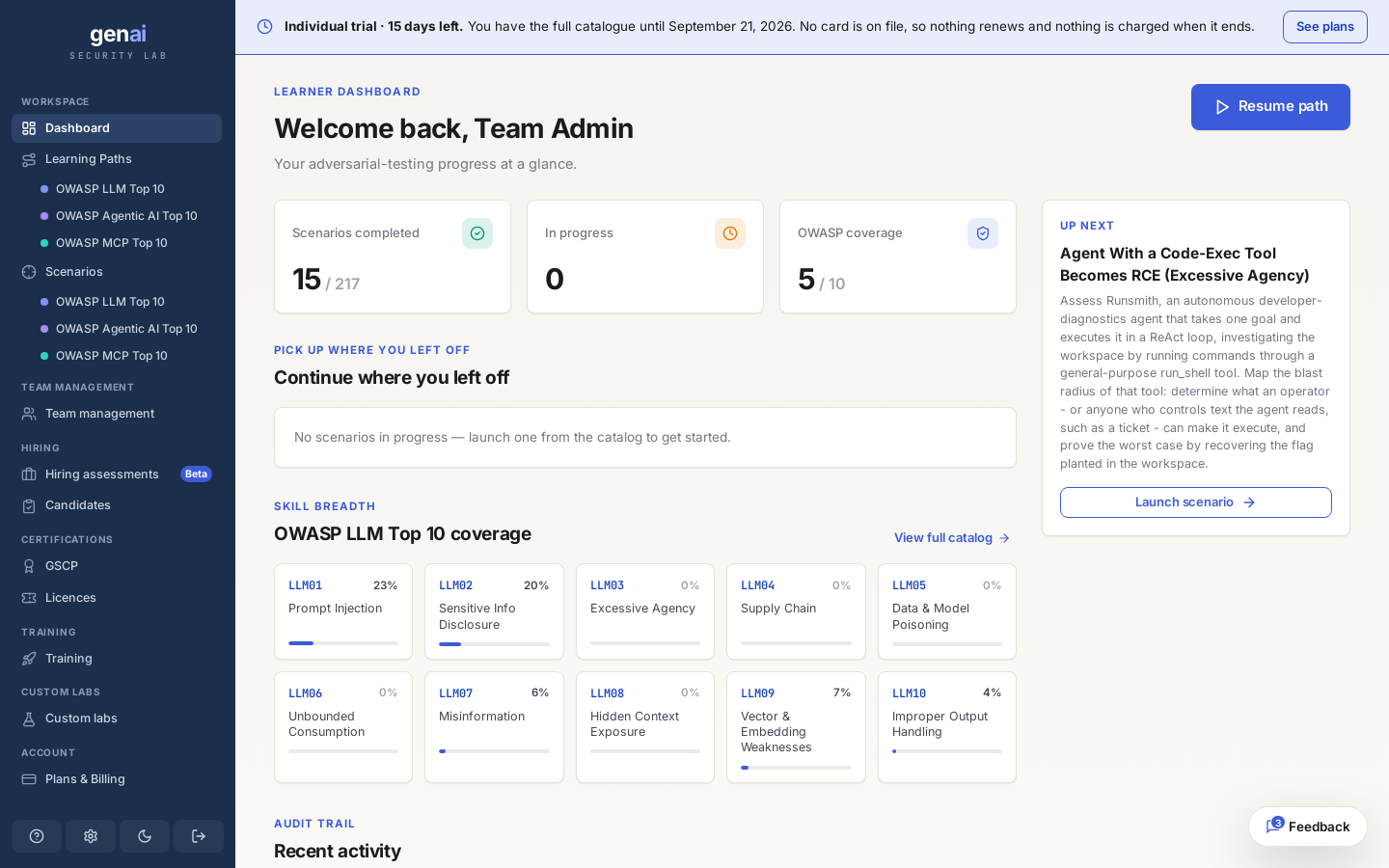
Your dashboard
Your dashboard is the starting point for a solo learner. It opens with three numbers: scenarios completed, scenarios in progress, and OWASP coverage. These give you a quick view of your progress before you decide what to do next.
Alongside them, Up next recommends a specific scenario, with a button to launch it. Resume path takes you straight back into your current learning path.
OWASP coverage
Progress is measured as coverage of the OWASP LLM Top 10. There is no single score. A grid shows all ten categories with a bar for each, so you can see your strengths and any categories you haven't practised.
Chase the gapsThe fastest way to broaden your coverage is to focus on your least-practised categories. Open the full catalogue from the coverage panel and filter to one you haven't tried yet.
Pick up where you left off
Progress is saved automatically as you go. Any lab you've started but not finished appears under Continue where you left off, where you can resume it with one click. A path you're partway through also remembers your place.
Recent activity
Further down the dashboard, Recent activity lists your latest sessions: the scenario, its category, whether you completed it, and when you started it. You can use this record to review your progress or find a lab to revisit. Your name, email and plan are under Settings and Plans & billing.
Results contain no lab spoilers, here or elsewhere on the platform. The history shows whether you completed a scenario without revealing what you found. See how grading works for what each band means.
Coverage and completed work
The platform deliberately has no points, streaks or leaderboards. OWASP coverage and completed work show you, or an employer, what you can do. They map your skills across the risk landscape.